Turning Around Hair Cuttery in Bankruptcy During Covid
Azhar Quader shares how Queens Court Capital rescued Hair Cuttery from bankruptcy, cut costs, and hit $17M EBITDA in under a year through special situations PE.


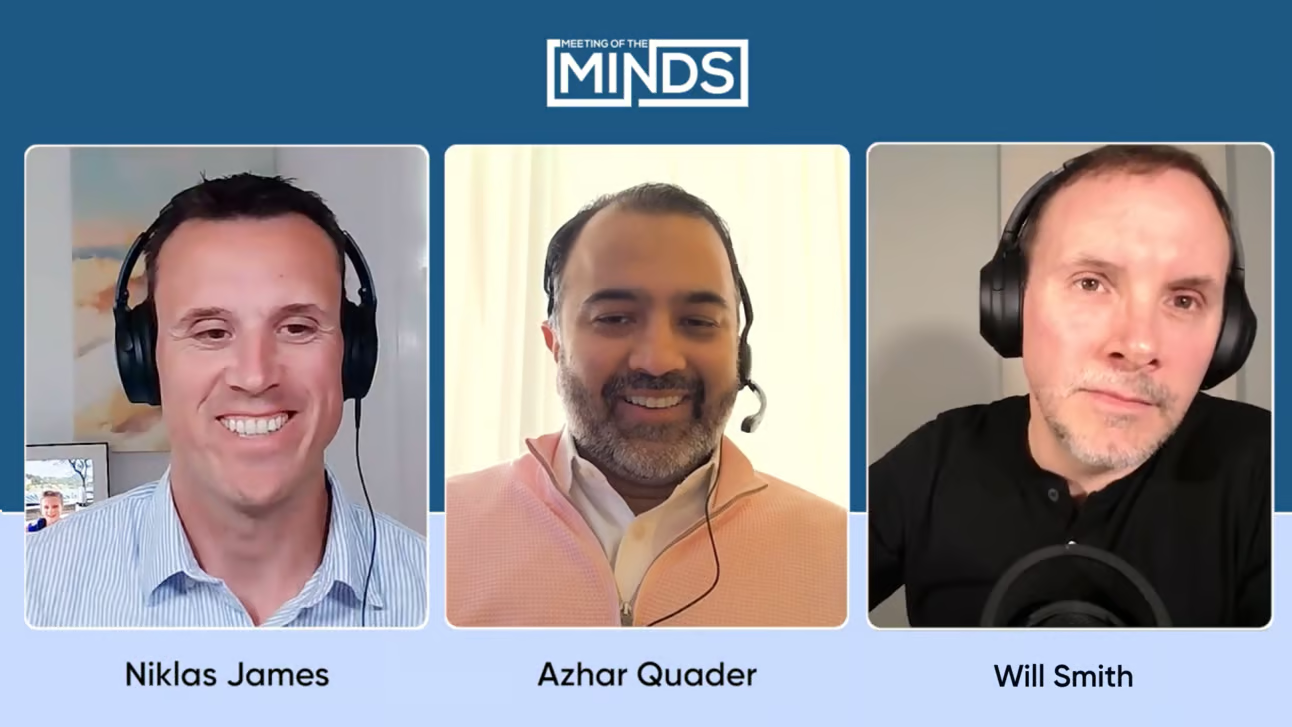
From large-cap finance at Advent and Morgan Stanley to lower-middle market PE at Hair Cuttery and The Pet Resort, Azhar Quader has a leading edge in special situations within deal-by-deal private equity.
Queens Court Capital built a track record through its expertise in special situations. The pinnacle thus far was the takeover of Hair Cuttery which they pulled through Chapter 11 bankruptcy and turned around to profitability less than one year later. They achieved this through cutting the number of stores from 800+ to approximately 500 and slashing operating expenses from almost $60 million to $19 million. It was a masterful turnaround.
"Most people when they hear special situations, they think distressed, they think restructurings. That certainly is part of it, but it's not the entirety of it. Special situations can also include carveouts, it could also include founder disputes. It could also include non-consensus or orphaned assets. It could also include operationally intensive opportunities that haven't been done before. What we'relooking for when we think of a special situation is a non-economic rationale for the transaction."
All of their targets must meet a 3-4x MOIC hurdle to be approved. Azhar tells how his company underwrites each deal with a 4-year base case investment horizon, which instills a sense of urgency compared to regular private equity, where the standard is 5 years.

Azhar also shares his experience with raising from high-net worth individuals and family offices versus private equity.
If you want certainty to close, sometimes PE is better than family offices and high networks. If you're solving for higher economics, in many cases, family offices and high net worth individuals will beat out whatever you can get on the private equity side.
Azhar’s latest platform is The Pet Resort, a roll-up in the pet boarding, day care, and hospitality space. This was more of a conventional independent sponsor deal, but Queens Court Capital partnered with Trivest, a PE fund, to have the requisite capital to scale fast, which contrasts the prior approach of fundraising from family offices and high-net worth individuals.
More recent episodes

The 3-5-7x MOIC Underwriting Framework
Princeton grad Rick Apple built Upside Growth Partners in Nashville, scaling 12 platforms while raising 5 kids. His strategic sourcing and 3-5-7 framework drive consistent success from retail to roofing.

A Portfolio Marked Up at 10x MOIC
Discover how Stenning Schueppert's radical alignment approach at Evolution Strategy Partners drives 10x returns in private equity, outperforming traditional fund models.
Combining 2 Platforms to Reach $20m EBITDA
Discover how Worklyn Partners combines VC-style cybersecurity with PE-driven MSP rollups, backed by $50M capital and 7 successful acquisitions to create a uniquely positioned dual platform.